

The European Industry
Use of marine nutrients
Marine ingredients—fishmeal and fish oil—play a highly targeted and strategic role in global food production. Their importance does not stem from bulk contribution, but from the specific physiological functions they support in animals, especially aquatic species. As the aquaculture sector continues to expand, the ability to produce healthy, high-quality seafood efficiently depends in part on the precise nutritional properties that marine ingredients provide.

A Limited Resource Used Strategically
One of the defining features of marine ingredients is that they are finite. Global production has remained relatively stable for decades, fluctuating with natural cycles rather than market demand. This finite nature has driven a shift toward strategic utilisation, where fishmeal and fish oil are no longer used as generic bulk ingredients, but are instead carefully allocated to the life stages and species where they add the most value.
This shift has been one of the major drivers behind the efficiency gains seen in aquaculture over the past 20 years. Even though inclusion levels have declined, performance has continued to improve—precisely because marine ingredients are now used more intelligently and in combinations that deliver the highest biological return.
Role in aquaculture
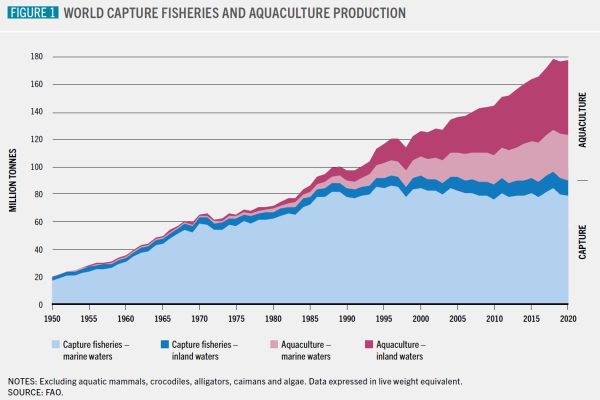
Aquaculture has become the fastest-growing food-production sector in the world, now supplying more than half of all seafood consumed globally. As wild-capture fisheries have plateaued due to natural limits, further increases in global seafood supply depend almost entirely on the continued expansion of aquaculture. This makes the sector central to future food security, nutrition, and sustainable protein production. One of aquaculture’s defining strengths is its biological efficiency. Many farmed aquatic species convert feed into edible protein more efficiently than terrestrial livestock, due to their ectothermic metabolism, buoyancy-supported bodies, and naturally high feed-conversion efficiency. These characteristics allow aquaculture to produce high-quality protein with comparatively low carbon emissions, minimal land use, and efficient resource utilisation.
Why Aquaculture Uses Marine Ingredients So Effectively
Aquaculture makes particularly efficient use of marine ingredients because their nutrient profiles align closely with the metabolic and physiological needs of aquatic species. Fishmeal and fish oil supply amino acids, long-chain omega-3 fatty acids, minerals, and other micronutrients that fish and shrimp have evolved to use over millions of years on naturally marine-based diets. This evolutionary match means the nutrients they provide are absorbed and utilised with high efficiency and minimal metabolic cost.
Even when included at relatively modest levels, fishmeal and fish oil exert disproportionate effects on growth and health. They support feed intake, improve feed conversion, and promote the development of muscle, organs, and other tissues. They also help animals buffer against environmental or physiological stress. Collectively, these effects reduce the overall feed required to produce a kilogram of farmed seafood—one of the reasons aquaculture remains one of the most biologically efficient protein-production systems.
Marine ingredients also provide a suite of functional benefits that extend beyond basic nutrition:
• Metabolic efficiency:
The amino-acid profile of fishmeal closely matches the requirements of many aquatic species. This reduces the metabolic energy spent on deamination and nitrogen excretion, allowing more of the diet’s protein to be directed toward growth.
• Cellular and immune function:
EPA and DHA are not simply sources of energy. They form part of cell membranes and act as precursors to signalling molecules that regulate inflammation, immunity, and stress responses. These pathways are especially important in intensive production systems.
• Early life-stage performance:
Larval and juvenile fish are highly sensitive to nutritional imbalances. The specific lipids and proteins found in fishmeal and fish oil support yolk-sac transition, organ development, early growth, and survival more effectively than most terrestrial ingredients.
• Product quality for consumers:
The fatty-acid composition of the diet influences the composition of farmed fish. Marine oils ensure that seafood remains an important dietary source of long-chain omega-3 fatty acids, a feature that underpins many of its recognised human-health benefits.
Together, these biological and functional attributes explain why marine ingredients, even when used sparingly and strategically, continue to play a critical role in supporting the performance, efficiency, and nutritional quality of modern aquaculture.
Efficiency and Environmental Contribution
The strategic use of marine ingredients plays an important role in aquaculture’s overall environmental performance. Because the nutrients in fishmeal and fish oil are readily absorbed and metabolised by aquatic species, they support high growth rates with comparatively low inputs. This contributes to several well-documented efficiencies:
-
Low greenhouse gas emissions per kilogram of edible protein, as efficient nutrient utilisation reduces feed requirements and associated upstream emissions.
-
Minimal land use, since marine ingredients do not require farmland, fertilisers, or deforestation to produce.
-
Efficient water use, with no reliance on freshwater or irrigation, in contrast to many terrestrial feed crops.
-
High nutrient retention, meaning a larger proportion of dietary nitrogen and phosphorus is converted into animal growth, and less is lost to the environment.
The sector’s environmental footprint is further improved by the increasing use of trimmings from food-fish processing. Today, roughly one-third of global fishmeal production is derived from these by-products. This practice strengthens the circularity of the food system by converting materials that would otherwise go to waste into high-value, nutrient-rich ingredients for food production.