

Responsible Sourcing
Raw materials
Biology
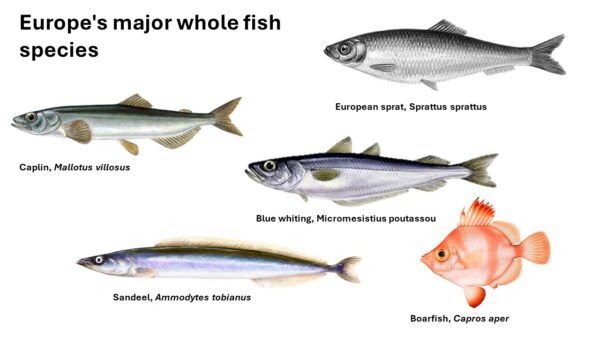
Fishmeal and fish oil production in Europe rely largely on small, short-lived pelagic fish species that are not commonly eaten by humans, as well as on trimmings generated from fish processing. These species share similar biological characteristics: they are fast-growing, short-lived, and experience naturally high mortality rates, resulting in rapid population turnover. Their abundance can fluctuate widely from year to year, strongly influenced by environmental factors such as temperature, salinity, and food availability.
The main pelagic species used include capelin, blue whiting, sprat, sandeel, boarfish, and Norway pout. Each plays a distinct ecological role.
Management of raw material for European fishmeal and fish oil production is grounded in established fisheries science and regulatory frameworks. Catch limits are set using biological assessments from ICES and are implemented through national and EU management systems. These fisheries operate under monitoring and control measures designed to keep exploitation rates within agreed reference points and to support the long-term stability of the stocks. An increasingly significant share of production now comes from trimmings — the parts of the fish that remain after filleting. With fillet yields typically ranging from 30% to 65%, the leftover material provides a valuable and fully utilised input for fishmeal and fish oil. By converting these unavoidable by-products into high-quality nutrition for aquaculture and agriculture, the industry plays a key role in the circular blue bioeconomy.
Fishing methods and usage
These fisheries are conducted using midwater (pelagic) trawls that target shoaling fish in the water column. Because the gear is designed to operate off the seabed, it generally avoids the benthic impacts associated with bottom-contact fishing. After landing, the catch is typically processed quickly to preserve quality for fishmeal and fish oil production.
As these species are not major sources of direct human consumption, they are managed under frameworks tailored to their biology and ecosystem role. Their life-history traits—fast growth, short lifespan, and high natural mortality—mean that exploitation rates are usually set well below natural mortality. Even so, these stocks are sensitive to environmental variability, especially recruitment strength and broader oceanographic conditions. For this reason, they are monitored through regular scientific assessments to ensure management remains aligned with observed stock dynamics.