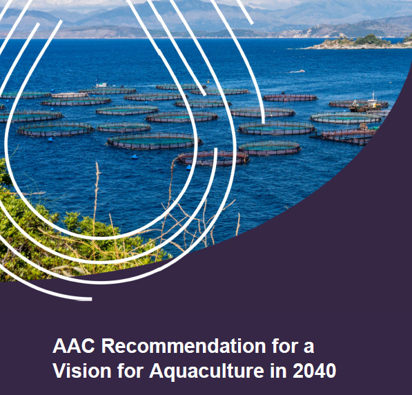
Shaping the Future of European Aquaculture: A Vision for 2040
2025.9.16
The Aquaculture Advisory Council (AAC) has recently published its advice on a Vision for Aquaculture in 2040. EFFOP is proud to be an active member of the AAC and to have contributed to this strategic document, which sets an ambitious path for the sector and highlights its indispensable role in ensuring food security, sustainability and resilience for the European Union.
Aquaculture can no longer be treated as a secondary element within the Common Fisheries Policy. Rather, it should be recognized as a primary food producing sector, similar to agriculture, and given a specific policy framework that reflects its strategic importance for Europe’s food autonomy.
A Vision for Aquaculture in 2040
Aquaculture should develop into a dynamic and competitive industry, making a significant contribution to the EU’s food supply, reducing import dependency and driving innovation. In 2022, the EU produced around 1.1 million tons of aquaculture products but imported twice as much. Closing this gap is essential: increasing production by 75,000 tons per year could halve import dependency by 2040 and strengthen the Union’s resilience in the face of global challenges.
The vision sets out a future where aquaculture is economically viable, environmentally sustainable and socially responsible. This means aligning aquaculture policy with broader EU food strategies and ensuring coherence across agricultural, environmental and health frameworks. Crucially, the AAC stresses that a new vision will only succeed if persistent implementation failures, such as limited access to space and water, complex administrative burdens and weak data collection, are resolutely addressed.
The document also recognizes the contribution of aquaculture to ecosystem services through low impact and low trophic systems, as well as the importance of valorising by-products such as marine ingredients, which play a critical role in circular feed systems. EFFOP particularly welcomes this recognition as the sector has long advocated for the sustainable use of marine resources to improve feed efficiency and support the development of low carbon aquaculture.
Key Recommendations
The AAC outlines a comprehensive set of recommendations to the European Commission, structured around the principle that aquaculture should reflect the ambition and scope of the Vision for Agriculture and Food (see EFFOP’s article). Key proposals include:
- An independent EU Vision for Aquaculture, in line with the Union’s objectives for food autonomy, food security and resilience.
- A Blue Foods Action Plan to complement the Aquaculture Vision and strengthen the EU’s aquatic food system.
- Binding and progressively increasing EU targets for sustainable aquaculture production to ensure measurable progress., and a binding Strategic Aquaculture Action Plan post-2030, guiding Member States towards the production of healthy, sustainable and welfare-friendly aquaculture products.
- The inclusion of aquaculture in future EU legislative and policy frameworks, in particular on climate adaptation, animal welfare and public procurement.
- Stronger sustainability clauses in trade agreements to ensure that imported aquaculture products meet EU equivalent social, environmental and animal welfare standards.
Within this broader vision, EFFOP emphasizes two priorities that are crucial both for the aquaculture sector and for European society as a whole:
- Recognition of seafood production, including fishmeal and fish oil, as a pillar of EU food security. Seafood must be fully integrated into EU food policy, reflecting its essential contribution to nutrition, sustainability and global food supply chains. Marine ingredients are essential components in aquaculture feed and play an irreplaceable role in ensuring the nutritional quality of farmed fish, thereby supporting Europe’s ambitions for a healthier and more sustainable diet.
- Mandatory labelling of health information on seafood products. Informed consumer choice is central to a resilient and sustainable food system. Labelling that communicates the unique nutritional benefits of seafood – such as omega-3 fatty acids – would not only empower consumers but also highlight the role of seafood in balanced diets and public health strategies.
A Call for Action
These recommendations reflect the need for a paradigm shift: from fragmented and non-binding measures to a coherent and ambitious framework that positions aquaculture as a driver of sustainable growth. As global challenges from climate change to geopolitical instability intensify, the strategic importance of a safe, sustainable and nutritious food supply cannot be overstated. Aquaculture, supported by marine ingredients, is uniquely positioned to contribute to this future.
EFFOP stands ready to continue to play its part in shaping this future: one in which seafood and the essential role of our industry are recognized as vital contributors to Europe’s food security and public health.
Click here to access the AAC Recommendation for a Vision for Aquaculture in 2040.