
SFP 2024 Reduction Fisheries Report highlights ongoing need for stronger industry engagement in and support for fisheries improvements
2025.7.11
The Sustainable Fisheries Partnership (SFP) has released its 2024 Reduction Fisheries Report, providing a fresh assessment of the management and stock status of key fisheries used primarily for the production of fishmeal and fish oil. The report evaluates 26 fisheries targeting 22 different stocks—mostly small pelagic, forage species—across the Atlantic and eastern Pacific Oceans. SFP takes a sectoral approach to seafood sustainability, using its public FishSource database to provide actionable insights to the supply chain. These overviews are intended to support supply chain actors in incorporating robust sustainability criteria into their sourcing and procurement decisions.
How SFP assessments work
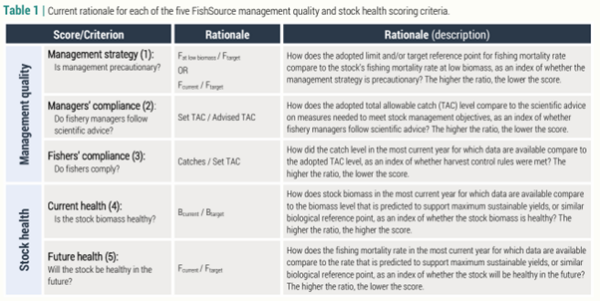
SFP assessments are based on the most recently available public data as of February 2025 and reflect conditions from 2024 for management quality and stock health indicators. Its catch statistics generally refer to 2023, latest. Each fishery is scored across five FishSource criteria: three related to management (precautionary strategy, managers’ compliance, and fishers’ compliance) and two related to stock health (current and future status). These scores are then used to place fisheries into one of five categories—from Category A to Category C.
Fisheries that score below 6 on any one criterion are considered Category C, while those that meet or exceed all thresholds—but include data gaps—are placed in Category DD. This scoring framework allows supply chain actors to compare fisheries consistently and track progress over time.
EFFOP fisheries included in the overview
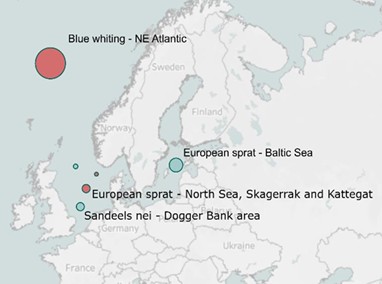
The 2024 SFP report includes eight key European forage fisheries relevant to EFFOP members. These include sprat, sandeel, Norway pout, capelin, and blue whiting stocks across the Baltic, North Sea, and Northeast Atlantic. Together, they represent the core raw material sources for fishmeal and fish oil production in Northern Europe.
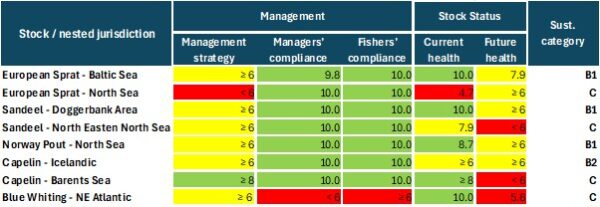
The 2024 SFP report categorised three of the eight EFFOP-relevant fisheries—Baltic sprat, Dogger Bank sandeel, and Norway pout—as Category B1, indicating reasonable management and good stock condition. Icelandic capelin was placed in Category B2, meeting basic management thresholds but with more moderate stock health scores. The remaining four fisheries—North Sea sprat, Northeastern North Sea sandeel, Barents Sea capelin, and NE Atlantic blue whiting—were classified as Category C, due to at least one FishSource score falling below 6. In these cases, lower scores were typically associated with stock status indicators (current or future health) or management strategy components.
These results reflect a snapshot in time, based on the most recently available public data. While the scoring highlights areas of concern, it also brings attention to the underlying complexity of assessing small pelagic fisheries—especially in data-poor contexts or shared management regimes. These aspects are explored further in the next section. In response to these findings, the report also highlights a set of priority actions to support improvement. Key recommendations include establishing long-term, ecosystem-based management objectives that account for both target species and broader food web dynamics, as well as strengthening data collection and ensuring regular, science-based stock assessments. These actions are particularly important for maintaining credibility and resilience in the face of environmental variability and growing demands for sustainable sourcing.
European Sprat- Baltic Sea
For European sprat in the Baltic Sea, the management strategy was scored ≥6. Fishing mortality has remained stable and below critical thresholds but continues to exceed precautionary reference points. A formal harvest control rule has not yet been adopted, and while compliance with TACs has improved in the most recent season, it has been inconsistent over the past decade. Additional concerns include persistently low recruitment, inconsistent application of management measures across jurisdictions, and limited data coverage—particularly from Russian sources. Nonetheless, the use of ICES advice and the existence of a multiannual plan support the rationale for a moderate score.
European Sprat- North Sea
For North Sea sprat, the SFP report reflects a sharp decline in stock condition based on 2024 data, with spawning stock biomass falling to just 84,000 tonnes—around 80% of the limit reference point—and fishing mortality reaching its highest recorded level. Management was noted as weaker than in other North Sea fisheries, with no multi-annual plan in place and concerns about the precautionary nature of interannual quota transfers.
However, the stock is scheduled for a benchmark assessment that will incorporate revised biological parameters, which may strengthen the management strategy going forward. More importantly, the latest ICES advice for 2025 indicates a marked recovery: spawning stock biomass is now estimated at nearly 275,000 tonnes—well above all key reference points—and catch advice for 2025–2026 has increased by over 200%, driven by exceptionally strong recruitment. These developments suggest the stock is currently in improved biological condition and underscore the importance of aligning performance evaluations with the most up-to-date scientific evidence. EFFOP anticipates that, based on this recovery, the stock may qualify for a higher category in the next SFP assessment.
Sandeel – Doggerbank Area
The fishery was upgraded from Category B2 to B1 in the latest SFP assessment, reflecting improved stock condition. Spawning stock biomass has been increasing since 2019 and is now well above the target reference point. Exploitation remains within sustainable limits, and management is considered strong, with good alignment between scientific advice, policy decisions, and industry compliance.
Sandeel – Northeastern North Sea
This fishery was downgraded from Category B1 to C due to a sharp decline in spawning stock biomass, despite fishing mortality remaining below precautionary levels since 2020. Recent projections suggest that SSB will fall below the limit reference point in 2025 and continue to decline into 2026—even under a zero-catch scenario. These trends appear to be driven more by environmental variability and poor recruitment than by fishing pressure, especially given that the TAC has been set at zero for the past two years. While the current trajectory is concerning, it is important to consider the biology of sandeel—a short-lived species with highly variable recruitment influenced by environmental conditions. The existing management framework, including the use of a precautionary Fcap, is designed to account for such fluctuations. As such, uniform scoring approaches may not fully capture the dynamics of environmentally driven stocks like this one.
Norway Pout – North Sea
Norway pout remains in Category B1, supported by a long-term trend of healthy stock biomass—above target reference points for the past 18 years—and low fishing mortality, which has decreased substantially over the last two years. Management is considered robust, with strong compliance by both managers and fishers, use of sorting grids, and real-time TAC adjustments within the fishing year. However, the outlook for 2025 is more cautious. ICES has advised a zero TAC due to a projected drop in spawning biomass below the limit reference point, largely driven by weak recruitment in recent years. Even under a zero-catch scenario, biomass is forecast to decline further through 2025.
Capelin – Icelandic
This fishery remains in Category B2, supported by the existence of a harvest control rule (HCR) that incorporates ecosystem considerations and uncertainty, including capelin’s role as a key prey species. The HCR has been evaluated by ICES as precautionary, and recent management has shown strong compliance with scientific advice, including full adherence to zero-catch limits in recent seasons. While the current HCR is functioning within a precautionary framework, EFFOP supports the call for a new benchmark review to ensure the management approach remains fit for purpose given the species’ biological and ecological complexity. Capelin will have a TAC of 46,384 tonnes for the 2025/2026 season, the spawning-stock size in 2025 is above Blim and the juvenile index is above Utrigger meaning there is possibility for fishing opportunities.
Capelin – Barents Sea
The stock’s outlook has deteriorated compared to last year. Although spawning biomass in spring 2024 was above the Bescapement reference point used in the harvest control rule, the maturing biomass estimated in autumn 2024 was less than half that of the previous year. Projections for spring 2025 indicate a sharp decline, and even under a zero-catch scenario, there is less than a 95% probability that spawning stock biomass will remain above Bescapement. This increased uncertainty in recruitment and stock development contributes to the fishery’s current Category C status.
Blue Whiting – NE Atlantic
This fishery remains in Category C, primarily due to concerns over management implementation and future stock health. While a long-term management strategy has been in place since 2018, its execution has been inconsistent, with unilateral quotas and catches above ICES-recommended levels. Although the stock remains in strong biological condition, with high biomass and stable recruitment, the elevated fishing pressure presents risks if not addressed. Manager compliance was scored below 6 due to persistent deviations from scientific advice and the absence of a sharing agreement among Coastal States. Fishers’ compliance, however, was scored ≥6, as overages reflect national decisions rather than non-compliance at the fleet level. At this juncture, it is important to note that ICES stock assessments are based on observed catches, meaning that catch overages are fully accounted for in the annual stock assessments, this means that the advice remains grounded in real data and accurately reflects the total fishery removals. We stress that the current challenges reflect a failure of international governance, not a biological collapse. EFFOP calls for an urgent need for the sustainable and equitable management of Northeast Atlantic pelagic fish stocks.