Global seafood production is set to grow again in 2025 – Aquaculture is now the engine of global supply
2025.11.24
New Food Outlook – FAO releases its biannual report on global food markets
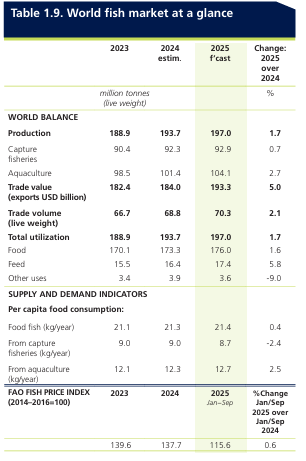
Global seafood production is set to grow again in 2025, with the Food and Agriculture Organization of the United Nations (FAO) forecasting total fisheries and aquaculture output to reach 197 million tonnes. This represents a 1.7 percent increase – or 3.3 million tonnes – compared with 2024. Export value is also projected to rise, reaching USD 193.3 billion, a 5% increase over 2024, underscoring the sector’s essential role in global food systems and international trade.
Most of this growth comes from rising consumption of seafood for direct human food, which is expected to climb to 176 million tonnes (+1.6%). Notably, demand for seafood used in feed production is forecast to grow even faster, increasing to 17.4 million tonnes — a 5.8% rise — reflecting the continued expansion of aquaculture and the essential role of marine ingredients in supporting healthy and efficient farmed fish production.
Aquaculture is now the engine of global supply
According to the Food Outlook, aquaculture will once again be the primary driver of growth. Production is projected to reach 104.1 million tonnes in 2025, expanding by 2.7 % compared with 2024. While growth in tilapia production has slowed, other major farmed species – including carp, salmon, catfish, and shrimp – are expected to see strong upward trends. This continues the long-term trajectory that has seen aquaculture surpass capture fisheries as the dominant source of aquatic foods for human consumption.
Capture fisheries remain stable amid stock constraints
Capture fisheries output is forecast to remain relatively stable at 92.9 million tonnes in 2025, a modest 0.7 % increase. However, the FAO notes that recent scientific advice has called for further reductions in several key stocks such as cod, haddock, and mackerel. These recommendations are expected to reduce catches in those fisheries, contributing to tighter supply in certain whitefish and pelagic categories. This tightening is already reflected in price movements within the FAO Fish Price Index, where whitefish and pelagic species from capture fisheries have seen some of the strongest increases in 2025.
Fish prices rebound in 2025
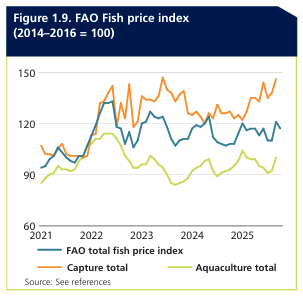
After falling in the early months of 2025, fish prices have since rebounded. The FAO Fish Price Index reached 121 points in September, slightly above its level at the beginning of the year.
Key trends include:
-
Capture fisheries prices have risen sharply, particularly for pelagics (excluding tuna), which increased by 50 points since January.
-
Whitefish prices climbed 11 points, reflecting tightening supply.
-
Aquaculture prices, after an early-year dip, have recovered and now exceed levels seen in September 2024.
-
Shrimp prices rose 11 points during 2025, emerging from a prolonged period of depressed values.
-
Salmon prices, by contrast, declined 11 points due to increased supply.
Overall, price signals reflect a tightening of certain wild capture markets alongside renewed strength in farmed species such as shrimp.
A sector still expanding — and increasingly shaped by aquaculture
The 2025 forecast reinforces a clear long-term trend: aquaculture is steadily reshaping the global seafood landscape. As farmed production continues to outpace capture fisheries, its influence on seafood availability, international trade, and the demand for raw materials is becoming even more pronounced. For the marine ingredients sector, this shift translates into sustained and evolving demand. Rapidly growing aquaculture industries rely on high-quality, responsibly sourced marine ingredients to support fish health, growth, and welfare. At the same time, expectations around transparency, traceability, and science-based resource management continue to rise, placing added importance on stable, well-governed supply chains. Against this backdrop of expanding production, active trade, and firming prices, the FAO’s latest Food Outlook highlights how central fisheries and aquaculture have become to global food security, rural livelihoods, and international markets — and how their future will increasingly be driven by the continued rise of aquaculture.
The report can be downloaded here.