

Focus on fishmeal: key takeaways from FAO’s report on Responsible use of fishmeal in aquaculture
2026.4.14
In the report Responsible use of fishmeal in aquaculture (2025) FAO explores how the fed aquaculture sector has advanced and improved the use of fishmeal as a feed source based on recent scientific and technological developments.
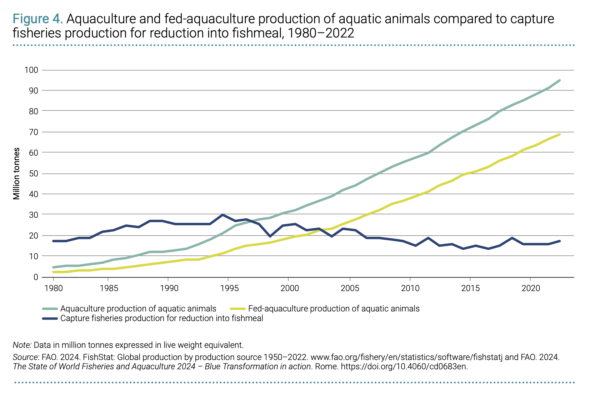
The report highlights that the use of fishmeal in feed for aquaculture has declined over time, even though aquaculture production continues to grow. This suggests that the growth in aquaculture has not driven an increase in captured fisheries used for reduction into fishmeal.
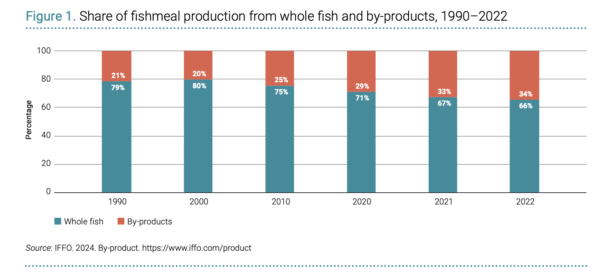
Meanwhile, a growing share of fishmeal is produced from by-products, rather than whole fish, supporting a more resource-efficient value chain.
With global aquaculture projected to increase, fishmeal must be used as a strategic ingredient and alternative feed ingredients must be developed. The report identifies four main approaches for this development:
- Selective use of fishmeal. By selectively including fishmeal in specific stages of aquaculture production the overall inclusion of fishmeal is reduced.
- Improving feed and feeding efficiency. Advances in feed formulation and feeding practices have improved growth, survival, and feed conversion ratios reduce the use of fishmeal.
- Supporting non-fed and low-input aquaculture. The increasing production of species that do not rely on feed, such as filter feeders and low-trophic species, decreases demand for fishmeal.
- Identifying alternative ingredients. Efforts are ongoing to develop and scale alternative protein sources that can partially replace fishmeal without compromising performance.
However, despite introducing current strategies to reduce fishmeal use in aquaculture, the report emphasises that replacing fishmeal is not straightforward. Several factors must be considered when searching for ingredients to replace fishmeal in fed aquaculture.
Alternative ingredients often struggle to match its nutritional profile and performance, while also facing challenges related to availability, cost, and consistency.
Environmental and social considerations, as well as competition for raw materials and climate-related risks, further complicate substitution.
The report therefore highlights that feed formulators must strive to produce feed with available, low-cost ingredients that have low environmental and social impacts and that meet the nutritional requirements of aquaculture species, to ensure a sustainable intensification and expansion of global aquaculture.
Moreover, it also points to the importance of improving the traceability of fishmeal sources and other current and potential ingredients to ensure that they do not compromise the food or nutritional security of consumers.
To read the full report, click here.
