Farmed Atlantic Salmon Safe but lower on Omega 3s, Long-Term Study Finds: EFFOPs analysis
2025.6.10
A major long-term study from the Institute of Marine Research in Bergen has revealed how the quality of farmed Atlantic salmon has changed over the past 16 years. Published in the Journal of Agriculture and Food Research, the study highlights a clear trade-off: salmon fillets today are safer to eat, with lower levels of harmful contaminants, but they also contain fewer important nutrients—especially the omega-3 fatty acids EPA and DHA.
In the past, feeds for Atlantic Salmon were based on high inclusion of marine ingredients like fishmeal and fish oil, sourced from pelagic fish, which are rich in the long-chain omega-3s that are important to both fish health and human nutrition. But as global aquaculture expanded and marine resources became more limited and costly, feed producers began replacing fishmeal and fish oil with plant-based ingredients such as soy and rapeseed oil. By 2020, the share of marine ingredients in the diets of Atlantic Salmon was down to 24% from, 90% in the 1990s.
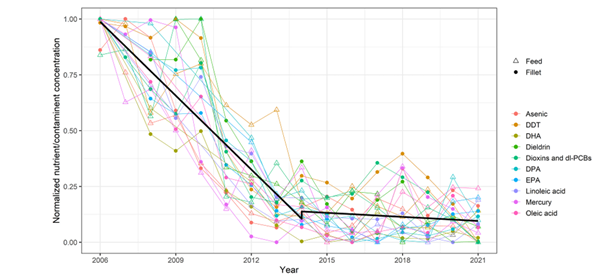
To understand this in detail, researchers at IMR analyzed nearly 7,000 salmon fillets, 900 feed samples, and 600 samples of raw feed materials between 2006 and 2021. The researchers found that omega-3 levels in feed dropped significantly between 2006 and 2014, then stabilized, which mirror a steep decline in marine oil inclusion in feeds between 2000 and 2020. The stabilization after 2014 likely reflects industry efforts to ensure salmon still receive the minimum levels of omega-3s needed for healthy growth and performance. At the same time, the study found contaminant levels—such as dioxins, PCBs, mercury, and arsenic— decreased significantly over the same period in both feed and fillet samples. These contaminants were associated to marine-based ingredients, which, like all natural sources can be exposed to environmental pollutants.
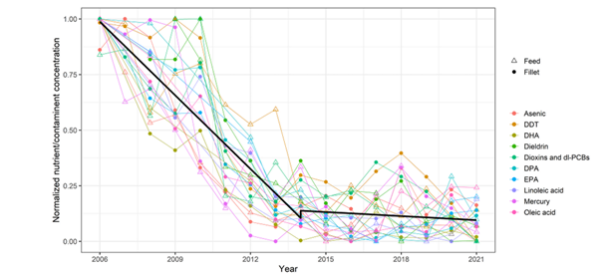
Trends in selected nutrients and contaminants in fish feed and Atlantic salmon fillets from 2006 to 2021
Since 2002, the European Union has enforced strict feed and food legislation that sets maximum limits for undesirable substances in feed materials. The implementation of this regulatory framework has played a central role in ensuring that products entering the aquaculture value chain meet stringent safety standards.
In parallel, the European marine ingredients industry has made substantial progress in eliminating contaminants such as dioxins and PCBs from fishmeal and fish oil. Through rigorous sourcing practices, improved processing technologies, and industry-led quality assurance schemes, the sector has significantly enhanced the safety profile of marine-derived feed ingredients. As a result, the situation today is far more controlled and transparent, with industry and regulators working together to ensure that marine ingredients continue to be both safe and nutritionally valuable components of aquafeeds.
While the biggest shifts in nutrient and contaminant levels took place between 2006 and 2014, the period since then has been marked by greater stability and consistency. These findings serve as a reminder of the strategic role marine ingredients play in aquafeeds—not just for supporting fish growth and health, but also for delivering nutritious seafood to consumers.