

Fact Sheet
The FMSY Project
Ecosystem Based FMSY Values in Fisheries Management
European Fishmeal was partner in the FMSY Project. The FMSY Project investigated a more ecosystem-based approach to estimation of the biological reference point Fmsy and the project was finalized on 1 May 2019.
European Fishmeal has received funding from the European Maritime and Fisheries Fund, the Ministry of Environment and Food of Denmark and Nordic Council of Ministers

The project results have been published by the the Nordic Council of Ministers. The two main publications are:
“Global fisheries catches can be increased after rebuilding of fish populations” available for download click here and a scientific article in ICES Journal of Marine Science “Estimating Fmsy from an ensemble of data sources to account for density dependence in Northeast Atlantic fish stocks” click here

Three working group reports are also available:
Report of the 1st working group meeting on optimization of fishing pressure in the Northeast Atlantic, Copenhagen June 2017 – click here
Report of the 2nd working group meeting on optimization of fishing pressure in the Northeast Atlantic, Vancouver November 2017 – click here
Report of the 3rd working group meeting on optimization of fishing pressure in the Northeast Atlantic, Rhode Island March 2018 – click here
The project is led by Dr. Henrik Sparholt, Nordic Marine Think Tank (NMTT). To see the project participants click here
What is FMSY?
FMSY is a biological reference point for fisheries management. It is the fishing pressure that gives the maximum sustainable yield in the long term. In the past overfishing has been a common feature in most sea areas. Overfishing means that fishing pressure is higher than FMSY.
The objective of the FMSY project is to come up with FMSY values, which are based on ecosystem functioning, for each of ICES data rich fish stocks. These FMSY values can be applied directly by ICES in its routine fisheries advice. The aim is to bridge the gap between the science available and management.
Project results
Towards ECO-system Fmsy
The FMSY project propose a new set of Fmsy values for data rich stocks in the North Atlantic. They are without bias known to science and using the available science on ecosystem functioning …by way of:
- ”Bridging the gap” between science and scientific advice/management
- Bring multispecies and ecosystem science into Fmsy calculations
Basic ecosystem concepts:
- The production in an ecosystem is based on primary production.
- This production is moving up the food web.
- If fishing is too light:
-
- the fish stocks will be too large and burn too much production in metabolic maintenance (convert production to CO2)
- production which could otherwise have been harvested as fish meat.
- If the fishing is too hard: the fish stocks will be too small and not produce enough juveniles.
The FMSY project continued in the MSE project – read about it here
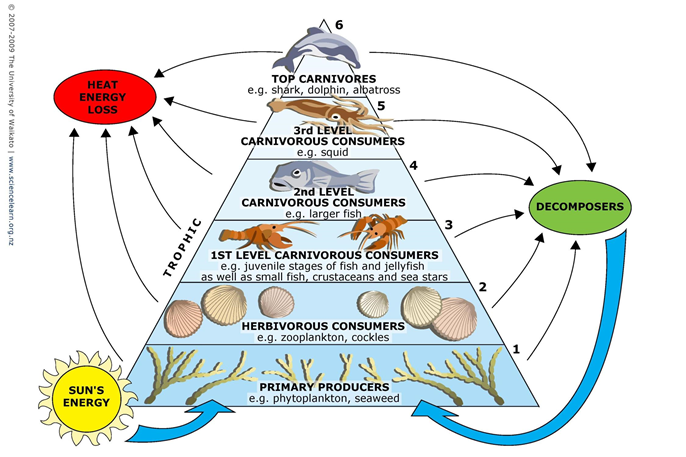
The report “Global fisheries can be increased due to rebuilding of fish populations” summarizes the results of the project. The project results present an approach which is simple and scientifically sound and builds on existing stock assessment framework as well as removes known bias in current methodology. This approach includes density dependent growth, reproduction and cannibalism, and it is based on single-species stock assessments. The project found increasing scientific evidence that multispecies MSY in a marine ecosystem requires fishing higher trophic levels at higher rates than FMSY as the foregone catch from higher trophic levels is compensated greatly by increases in catches from lower trophic levels. The report concludes that managing the Northeast Atlantic fisheries using the new FMSY values will increase the sustainable catches by several million t per year compared with a management based on the current FMSY values.
Results
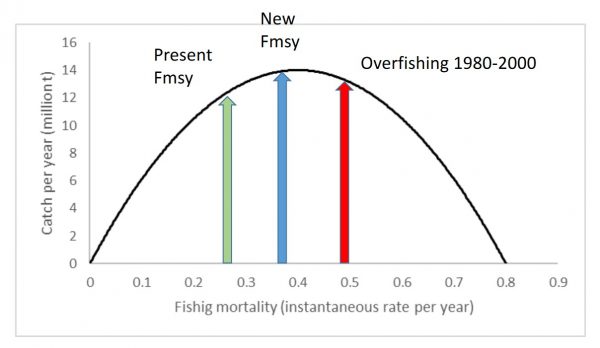
Overlay with catch in Northeast Atlantic
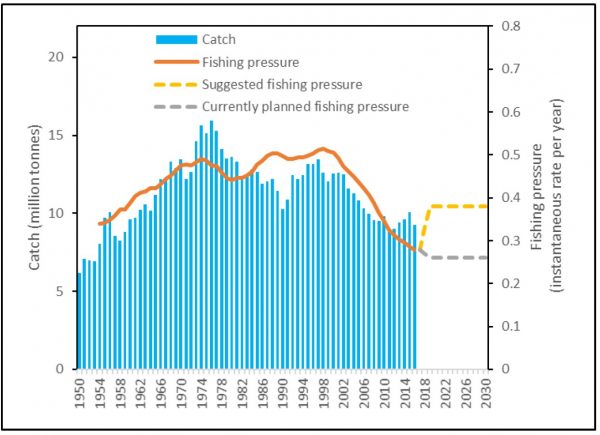
More results from the FMSY-PROJECT click the link: www.fmsyproject.net

Due to changes in markets and demands, there is an urgent need for improved knowledge about the nutritional value of fishmeal and oil and how to increase their value within the fish feed industry. To facilitate and strengthen the Nordic cooperation and bioeconomy, a Nordic Centre of Excellence in Fishmeal and Fish oil was established in 2018 with support from the Nordic Council of Ministers.
A project workshop took place the 14-15 November 2018 in Copenhagen – for information about the workshop and programme please click here
The project report is available for download click here
Background
The Nordic countries have played a leading role in providing healthy and safe products for human consumption from marine resources and it is important for the Nordic bioeconomy as a whole that this status is maintained. The research and innovation proposed by this Network Centre of Excellence is based on a sustainable bioeconomical approach within and across industry sectors, promoting interdisciplinary cooperation to enhance the Nordic economy. Its establishment is also in line with messages from the Fishmeal and Fish Oil Symposium organised in Hirtshals, Denmark from 29th-30th August 2016, see below.
Fishmeal and fish oil production play an important role in the Nordic countries. However, production has been static the last decade, while the world’s protein and oil demand has increased drastically, along with ever-increasing public demand for improved sustainability and increased use of marine and terrestrial animal by-products. The quality of fishmeal and oils depends very much on the properties of the raw material used. The fish species, ocean conditions (temperature, pollution, feed, other species) where the fish was caught, seasonal effects and preservation methods are raw material parameters that influence the processing, yield and nutritional quality of these products. Changes in market demands for alternative protein and oil sources both for human and animal consumption, as well as increased competition from fishmeal and oil substitutes (e.g. plant, yeast, algae and insect ingredients) call for improved knowledge and optimized processes and methods in the fishmeal industry in order to increase the nutritional and economical value of their products. This will benefit the entire value chain – fishery, industry, coastal regions and consumers and increase the export revenues of the industry. The price of fishmeal decreased from approximately 2,400 USD per tonne in June 2014 to 1,100 USD per tonne in June 2017, while the use of soy meal for animal feed increased at the expense of fishmeal. The price of starter feed with the right chemical and nutritional composition is currently around 3,000-5,000 USD per tonne, and prices for proteins for human consumption may reach 7,000 USD or even more. So there are many good reasons to optimize the processing methods and product quality of the Nordic industry and adapt them to a changed market atmosphere.
On 29-30 August 2016, 100 participants took part in a Symposium on “Perspectives for Fish Meal and Fish Oil in light of the management of forage fisheries, alternative uses of fishmeal and the development of new feeds and technologies”. The aim of the Symposium was to bring stakeholders together to discuss trends, challenges and opportunities for the fish meal and fish oil value chain.
Some of the things highlighted by the Symposium were:
- There is a need to cooperate with the fishermen with a view to ensuring that information and data are collected to improve stock assessments.
- Pelagic stocks are generally more vulnerable than demersal stocks, so particular attention is needed in stock assessments. In this respect, good and solid scientific advice is important for the stability and planning horizon of the industry.
- Rest raw material from food grade fish processing is an important and growing raw material source for the industry
- Perceptions about the fishmeal and fish oil value chain are often skewed and the industry needs to develop a communication strategy that can address this. Basically, the industry noted that it had not been good at explaining the sector to a wider audience.
- A network, such as the one created by hosting the Symposium, is central to improve communication among stakeholders.
- There is a need to advance the research agenda throughout the value chain i.e. from forage fishing (e.g. gear technologies that minimize the impact on ecosystems) at one end of the value chain to better understand the nutritional importance of the fishmeal and fish oil inclusion rates in aquaculture diets and fully understand the unique nutritional qualities of fishmeal and fish oil.
- Concerted action in exploration of the great potentials of mesopelagic fish stocks as future raw material for the pelagic industry is needed among all stakeholders, while caution should be exercised with such development.
- It was suggested that the Nordic regions might collaborate more intensely with a view to reducing the overall burden of research costs.
The Symposium participants highlighted the usefulness of having started a process but that the process needed to be followed up. In this regard, it was suggested that a platform could be developed which would provide a tool to communicate latest research and general news about the fishmeal and fish oil value chain.
The overall objective of this Network of Excellence is to continue the valuable cooperation launched by the Symposium. The work will meet the needs and demands concluded by the Symposium through a literature study and creation of a road map for future industry driven research in the field.
For more information, please contact European Fishmeal and Fish Oil Producers, click here.
Ecologically and economically sustainable mesopelagic fisheries (MEESO)
The MEESO project officially ended in February 2024.
In the MEESO project researchers looked—together with the industry—into whether organisms living deep in the oceans can be exploited in an ecologically and economically sustainable way.
EFFOP was partner of the MEESO project funded by the EU Horizon 2020 (Blue Growth), 2019-2023 and contributed its expertise from the fish processing aspect and protein concentration methods
Read about the MEESO project at the website: click here
The EU H2020 research project had 19 partners from 10 European countries and it is coordinated by Institute Marine Research in Norway. The kickoff meeting was held in Bilbao, Spain, from 24 to 26 September 2019.
The overall goal of MEESO was to quantify the spatio-temporal distributions of biomass, production and ecosystem role of mesopelagic resources and to assess options to sustainably manage and govern their exploitation. To reach this goal, MEESO created new knowledge and data on the mesopelagic community, its biodiversity, drivers of its biomass and its role in carbon sequestration, its role in the oceanic ecosystem and its interactions with the epipelagic community which includes several important commercial fish stocks. Besides applying state of the art experimental and quantitative methods, MEESO developed and implemented new acoustic and trawling technologies necessary for the knowledge and data generation in relation to this largely unknown and remote part of marine ecosystems.
MEESO applied the new knowledge and data to determine the potential of the mesopelagic biomass to be sustainably exploited for products included in the human food chain. For the first time combining leading experts in science, engineering, fisheries and governance, MEESO tested the ability to develop commercial fishing and processing technologies and mapping of contaminant and nutrient contents to explore the basis for a viable fishery and creation of jobs. Mesopelagic organisms represent one of the largest unexploited resource left in the world’s oceans, with a recent biomass estimate at 10 billion metric tons. The new tools and technologies, as well as assessment and management roadmaps, developed in MEESO helped the industry to understand more about the bottlenecks of implementing a fishery on such a novel and unexplored part of our oceans. There is still some way to go but we now have improved knowledge on the trade-offs between exploitation, sustainability and viability of the resource and options for its governance.
Can mesopelagic fish be used as feed sources for salmon aquaculture?
A recent article gives answers to the question, read the article: click here
The overall conclusions from the article are that the mesopelagic layer contains protein and lipid sources that could supply raw materials to the salmon aquaculture industry. However, high levels of wax esters, cadmium and arsenic needs to be addressed.
ICES explores the opportunities and risks of developing fisheries in the mesopelagic zocone – click here
Known as “the twilight zone”, the mesopelagic begins where only 1% of light reaches and ends where there is no light at all. Typically, this means that the mesopelagic extends from ca. 200–1000 metres below the water’s surface.
Mesopelagic organisms (mainly fish and squid) have long been proposed as a potentially harvestable resource and estimates suggest that the mesopelagic realm could contain a total fish biomass on the order of 2-19.5 gigatonnes, roughly equivalent to 100 times the annual catch of all existing fisheries.
As a result, and in the context of feeding an ever-growing human population, there is an increasing interest in their use for human consumption, fishmeal, as a source of dietary supplements for humans, and to bio-prospect pharmaceuticals.
The latest issue of ICES Journal of Marine Science takes a closer look at the opportunities and risks associated with the exploitation of mesopelagic resources – click here (This issue has open access – free to access for all readers).
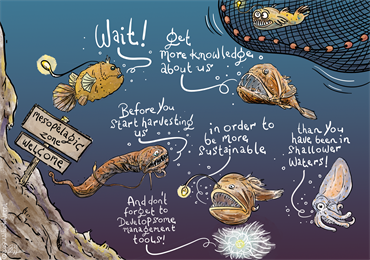
Drawing by Bas Kohler, source: ICES Journal of Marine Science

European Fishmeal is partner in the MSE project: “Development of Management Strategy Evaluations (MSEs) based on the Fmsy values obtained from the Fmsy-project for six high profile fish stocks“.
New Fmsy values were made available by the Fmsy-project (www.fmsyproject.net) for 53 data rich fish stocks in the North east Atlantic. These new Fmsy values were estimated using procedures that contained no bias known to science and were based on and consistent with the science available on ecosystem functioning. They can be used directly in fisheries management in the Northeast Atlantic.
One problem is however that if managers and stakeholders want to use complex Management Strategies, new Management Strategy Evaluations (MSEs) are needed. These can be age based for a few stocks where the relationship between stock size and growth, maturity and natural mortality are established. For most stocks alternative approaches are needed. The MSE project will develop these.
For more information visit the MSE project website: https://www.mseproject.org/