New model of PFAS transfer from feed to fillet in farmed salmon indicates low dietary exposure risk: EFFOPS analysis
2026.8.14
A new study modelling PFAS transfer from feed to fillet in farmed Atlantic salmon indicates that current commercial feed concentrations pose a low dietary exposure risk. Even when the model was run using the highest PFAS concentrations observed in Norwegian commercial salmon feeds, predicted concentrations of all four EU-regulated PFAS remained below the corresponding maximum levels established for fish intended for human consumption. The work is particularly timely. Maximum levels (MLs) are already established in the EU for four PFAS in fish intended for human consumption—PFOS, PFOA, PFNA and PFHxS—yet equivalent limits have not been established for fish feed. Bridging these two points requires more than simply knowing whether PFAS are present in feed. It requires an understanding of what proportion is absorbed, where individual PFAS compounds distribute within the fish, how quickly they are eliminated, and ultimately how much reaches the edible fillet.
The study by Ly et al., (2026) provides an important step towards answering that question.
From feed concentration to fillet concentration
The researchers exposed Atlantic salmon to six PFAS compounds—PFOS, PFOA, PFNA, PFHxS, PFDA and PFBS—during a controlled feeding experiment, followed by a depuration period. Concentrations were measured across ten tissues and used to construct a physiologically based kinetic (PBK) model describing the absorption, distribution and elimination of the individual compounds.
Importantly, the model does not treat the salmon as a static compartment. It incorporates a dynamic energy budget model describing changes in growth, feed intake and body composition as the fish develops. This matters because a farmed salmon increases several-fold in body mass during production. Growth therefore acts to dilute accumulated contaminants, while changes in fat deposition and tissue composition alter how compounds are distributed within the animal.
The resulting model reproduced PFAS concentrations across tissues during both accumulation and elimination and was subsequently evaluated against independent surveillance data from commercially farmed Atlantic salmon.
Following PFAS through the salmon: PFAS do not simply accumulate in fat
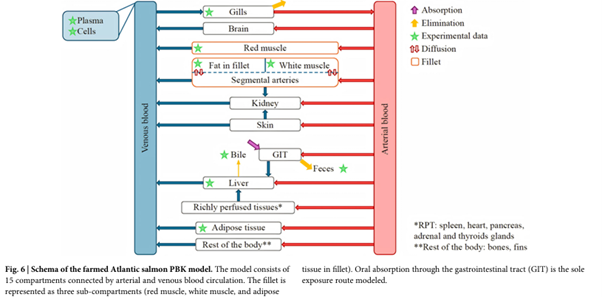
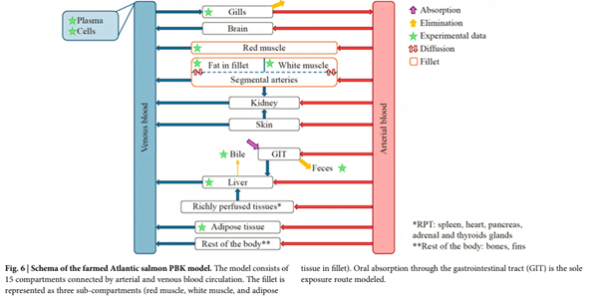
The model essentially provides a physiological map of what happens to PFAS after they enter the salmon through its feed. Rather than assuming a fixed proportion of PFAS in feed will appear in the fillet, the model follows their movement through 15 physiological compartments, connected by the fish’s arterial and venous circulation.
Dietary PFAS enter through the gastrointestinal tract before reaching the circulation and being distributed between tissues including the liver, kidney, gills, blood, adipose tissue and muscle. Importantly for food safety, the fillet itself is represented by separate red muscle, white muscle and fat compartments. The model then accounts for both the movement of PFAS between these tissues and their elimination from the fish.
This physiological approach matters because the concentration ultimately measured in a salmon fillet is the outcome of several competing processes: how much PFAS is absorbed from feed, where it partitions within the fish, how the fish grows, and how quickly the compound is eliminated.
One particularly useful aspect of the study is the insight it provides into how PFAS behave physiologically.
Unlike many classical persistent organic pollutants, such as PCBs, PFAS are not principally characterised by accumulation in lipid. They are proteinophilic. Their distribution is strongly influenced by binding to proteins in blood and tissues.
This was clearly reflected in the experiment. The highest dose-corrected PFAS concentrations occurred in plasma, followed by liver and red blood cells, whereas adipose tissue and the edible fillet contained among the lowest concentrations. Binding to plasma proteins, particularly albumin, helps explain this pattern. PFAS entering the circulation can bind strongly to plasma proteins, while only the unbound fraction is available for redistribution to tissues or elimination.
What happens when dietary exposure stops?
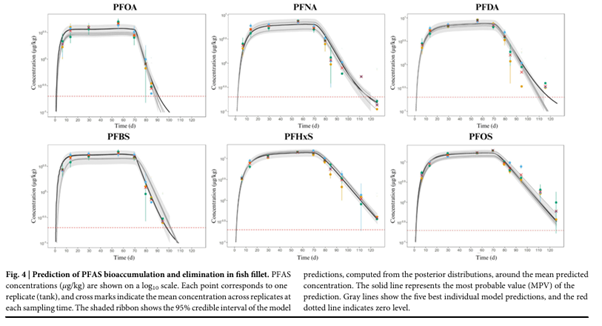
During the 70-day exposure period, concentrations of all six PFAS increased before approaching a relatively stable level. Once the PFAS-enriched feed was withdrawn, however, fillet concentrations declined markedly. The rate of this decline differed between compounds, reflecting differences in their distribution and elimination kinetics.
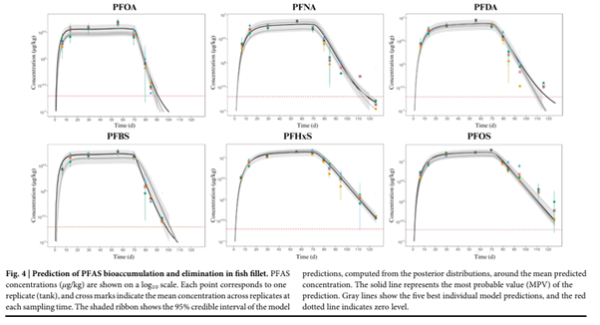
This is important when interpreting feed-to-fillet transfer. The concentration present in feed does not simply accumulate continuously in the edible tissue. Instead, fillet concentrations represent a dynamic balance between dietary uptake, distribution within the fish, growth dilution and elimination. The model estimated fillet half-lives of approximately 5–10 days for the four EU-regulated PFAS, demonstrating that elimination can substantially reduce concentrations once dietary exposure falls or ceases.
The figure also helps explain why the authors consider their food-safety simulations conservative. Commercial salmon are normally subjected to a pre-harvest fasting period, which was not incorporated into those simulations. Given the estimated fillet half-lives, the authors suggest that this period would be expected to further reduce PFAS concentrations before harvest.
Uptake is only part of the story
Perhaps surprisingly, the PFAS that accumulated most strongly were not necessarily those that entered the fish fastest. The model predicted that absorption from the gut became slower as the carbon chain became longer. This means that the greater accumulation of some longer-chain PFAS cannot simply be explained by greater uptake from the feed. Instead, what happens after a PFAS enters the bloodstream appears to be just as important—where it is distributed in the body, how strongly it is retained in different tissues, and how quickly the fish can eliminate it.
This leads to one of the more interesting findings of the study. The model estimated that approximately 98% of the elimination of free PFAS occurred through the gills, compared with around 1.8% through faeces and 0.2% through bile.
The gills therefore appear to be important not only for respiration, but also as a route for removing PFAS circulating in the blood. Under open seawater farming conditions, PFAS can move from the fish across the gills into the surrounding water, contributing to the decline in tissue concentrations when dietary exposure is reduced or stopped.
The authors caution that this may work differently where the surrounding water itself contains elevated PFAS concentrations. In such environments, exchange across the gills could potentially occur in both directions, and the model would need to account for PFAS entering from the water as well as leaving the fish.
What does this mean at commercial feed concentrations?
The practical relevance of the model becomes clearer when it is applied to PFAS concentrations actually measured in commercial salmon feeds.
Across Norwegian commercial feeds, concentrations of the four EFSA-regulated PFAS ranged from approximately 0.1 to 3.8 µg/kg wet weight. When these exposure levels were applied to the model, predicted concentrations in the salmon fillet remained low, at approximately 0.01–0.5 µg/kg wet weight.
PFOS provides the clearest example because it could be directly compared with independent commercial fillet data. At a mean feed concentration of 0.73 µg/kg, the model predicted a fillet concentration of 0.130 µg/kg. This closely matched the measured commercial concentration of 0.12 µg/kg, providing useful real-world validation of the model. More importantly from a food-safety perspective, this concentration represents only around 6% of the current EU maximum level of 2.0 µg/kg wet weight for PFOS in farmed salmon muscle.
The same picture emerged when the model was challenged with the highest PFAS concentrations observed in commercial feeds. Predicted fillet concentrations for all four regulated PFAS remained below their respective European maximum levels. In other words, even the upper end of PFAS occurrence currently observed in commercial feed did not translate into fillet concentrations approaching the regulatory thresholds.
The authors then tested a substantially more extreme scenario. Feed concentrations were increased to five times the highest levels observed commercially. Even under this scenario, PFOS only approached its maximum level in the fillet, while PFOA, PFNA and PFHxS remained below their respective limits.
This relationship could also be considered in reverse. Because predicted feed-to-fillet transfer remained linear across the simulated exposure range, the model could estimate the concentration in feed that would correspond to the existing maximum level in the edible fillet. These model-derived concentrations were 1.43 µg/kg for PFOA, 2.50 µg/kg for PFNA, 0.103 µg/kg for PFHxS and 11.24 µg/kg for PFOS.
These values are not proposed regulatory limits. Rather, they demonstrate an important principle for considering PFAS in aquafeed: the presence of a contaminant in feed is not, by itself, a measure of consumer exposure. What ultimately matters for food safety is how that exposure translates into concentrations in the edible product. By quantitatively linking these two points, the model provides a biological basis for evaluating feed concentrations in the context of existing food-safety limits.
Species-specific transfer matters
The broader significance of the study extends beyond the concentrations predicted for salmon alone. It demonstrates why PFAS transfer should not be assumed to follow the same relationship across different food-producing animals.
Atlantic salmon differ substantially from terrestrial livestock in their physiology, growth, plasma composition, tissue distribution and routes of elimination. The present study also shows considerable differences between individual PFAS within the same species. Carbon-chain length, functional group, tissue partitioning and elimination all influenced how much of each compound ultimately accumulated in the fillet.
An instructive contrast can be found in laying hens. Granby et al. (2024) investigated PFAS in Danish commercial organic eggs and identified fishmeal used in the feed as the likely source of the PFAS profile observed in the eggs. In this case, transfer into the edible product was much more pronounced, with the authors estimating that consumption of 5–6 of the investigated organic eggs per week by children could result in an exposure exceeding the EFSA tolerable weekly intake. This is a very different feed-to-food relationship from that observed in Atlantic salmon and provides a practical example of why transfer cannot simply be generalised between animal species.
This has an important implication for any future consideration of PFAS in animal feed. A concentration measured in feed cannot necessarily be assigned the same biological significance across species. Potential guidance values or maximum levels should therefore be informed by species-specific feed-to-food transfer, linking exposure through feed to the concentration that ultimately occurs in the edible product.
The model developed for Atlantic salmon provides a means of making that connection quantitatively. Under the commercial feed concentrations evaluated in the study, predicted concentrations of all four EU-regulated PFAS remained below their respective food maximum levels. This supports the authors’ conclusion that PFAS concentrations currently observed in commercial salmon feed present a low dietary exposure risk. This study represents an important advance in moving PFAS assessment from simply asking “how much is present in the feed?” towards the more biologically relevant question: “how much ultimately reaches the food we consume?” For farmed Atlantic salmon, the evidence presented here indicates that at current commercial feed concentrations, that transfer results in fillet concentrations well below existing European food-safety limits.